Crochet Pattern for a Doily Rag Rug Made from Bed Sheets

 ***You can find the PDF version of this pattern in my shop by clicking here. Great for easy printing!***

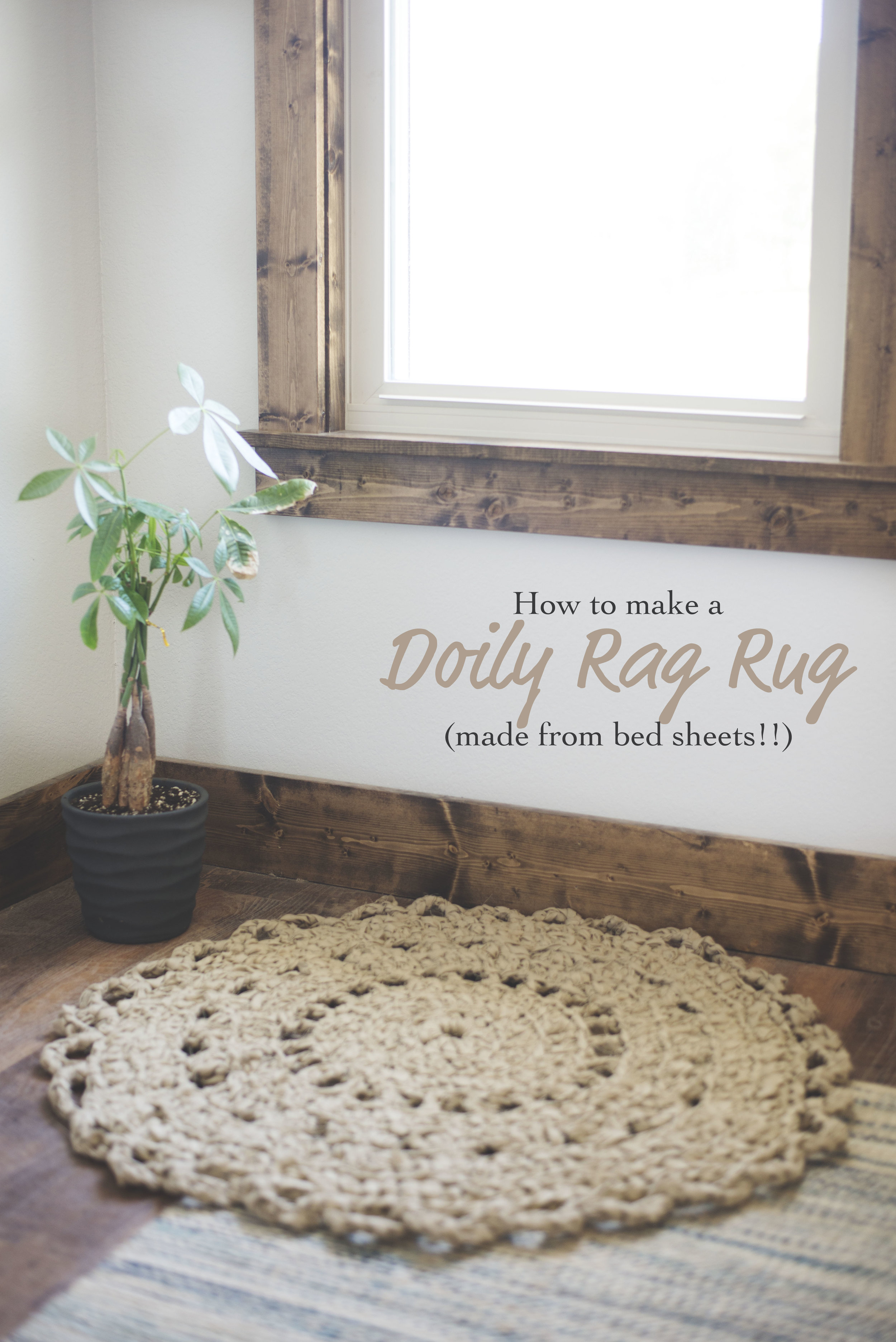
Let me start this post by saying that I am SO excited to get this rug out into the world. Ever since I spotted those beige sheets in Walmart on sale for $4.50, I knew I could come up with a cool project with them. And so here I am!

Seriously, its just a killer rug, perfect for a little nook, corner or in an office. And guess what? It's totally not that hard to make. I think the most time consuming part of this project was simply cutting up the sheets. Which by the way I used two sets of 120 thread count TWIN bed sheets (see below).

If you've never cut sheets or fabric to make your own yarn, I explain how to do it in this post. I cut my fabric at two inches wide, and used a 15 mm hook (find one here on Amazon).

Seriously, is this not just the coolest thing?? I think you need to make one. It's like rustic meets bohemian. And not to mention that you can say, "Yeah, I made that!" when someone swoons over it (am I the only one who gets a lot of satisfaction out of saying that when someone compliments a thing you made?).

Doesn't my friend's little girl look cute on it? I thought so. :)

The rug measures roughly 34 inches in diameter. And don't let me forget to mention that it only cost me 9 bucks! Yeah, if you can't tell... I'm pumped. And you may have sheets ALREADY in your house that you have in mind to use for this, so it may cost you nothing!

My living room floor, mid-sheet yarn cutting.

My living room floor, mid-sheet yarn cutting.

Since I used two twin sheet sets (two flat sheets, two fitted sheets) I'm betting that you could get away with using one queen set if you didn't have twin sized sheets.

This is what one twin sheet looks like rolled into a ball. :)

This is what one twin sheet looks like rolled into a ball. :)

What you'll need:
two twin sheet sets, or equivalent in larger sheets cut into 2" diameter yarn (tutorial here)
good sharp pair of scissors (you could even rip your sheets for more of a shabby look if your fabric allowed)
15mm crochet hook

Dimensions:
Rug measures approximately 34 inches in diameter

Abbreviations:
st(s)=stitch(es), sc=single crochet, dc=double crochet, sp=space, ch=chain, sk=skip, 3dcl=3 double crochet cluster, 4dcl=4 double crochet cluster, yo=yarn over

Stitch Explanations:
3dcl= (yo, insert hook into next st, yo, bring back through st, yo, draw through first two loops on hook), repeat () 3 times, yo, draw through remaining four loops on hook

4dcl= (yo, insert hook into next st, yo, bring back through st, yo, draw through first two loops on hook), repeat () 4 times, yo, draw through remaining five loops on hook

Notes:
-To join the ends, you could always just join how you usually do. But I followed this way of joining together ends found over on Oh You Crafty Gal:

-ch at the beginning of the rounds DOES NOT count as a st, unless otherwise noted
-since the yarn is so large, I found I had to change the way I held onto it while crocheting to make it more comfortable. Also, I found it kind of hard on the hands/wrists after awhile, and just took a little break when it became too much.
-I worked the majority of my stitches in the back loop only, only because I found it easier, I don't think it looks much different at all whether you do both or back only

Pattern
ch 10, join to 1st ch with sl st to form ring
1) sl st into the ring, ch 3, work 15 dc in circle (15)
2) ch 3, work 2 dc in each st around, join to 3rd ch with sl st (30)
3) ch 3, (2dc, dc) around, join to 3rd ch with sl st (45)
4) ch 5 (counts as dc, ch2), sk st, (dc, ch 2, sk st) around, join to the 3rd ch with sl st (23 total dc)
5) ch 3, (2dc, dc in next 3 sts) 16 times, 2dc, dc in last 2 sts (84)
6) ch 2, 3dcl (counts as 4dcl), ch 4, (4dcl, ch 4) 20 times, join to the st of the 3dcl with sl st (21 total clusters, 105 total sts)
7) ch 3, in same sp as ch 2: 2dc, dc in next 5 sts, (2dc, dc in next 5 sts) 16 times, 2dc, dc in last two sts, join to 3rd ch with sl st (123) 
8) ch 3, dc around, join to 3rd ch with sl st (123)
9) ch 7 (counts as sc, ch 6), sk 3 sts, sc in next st, (ch 6, sk 3 sts, sc in next st) 29 times, ch 6, sk 2 sts, join to 1st of beg ch

To weave in ends, I used my fingers and just wove them back and forth a few times, then tied a knot and cut the yarn. I tied the knot because you can't see it on the back side and for added assurance it won't come undone. 

You may have to stretch/block the rug to make it lay flat. You could use a little water, and tug it until it lays flat. All I had to do was tug it around a bit and it laid flat!

And there you have it! A beautiful new adorably shabby rug! I didn't even think it took that long to whip up. The massive size of yarn totally helped that out. 

What a cool project! I hope you enjoyed. :)

-Meg

Crochet Black and White Cross Pillow Cover Pattern

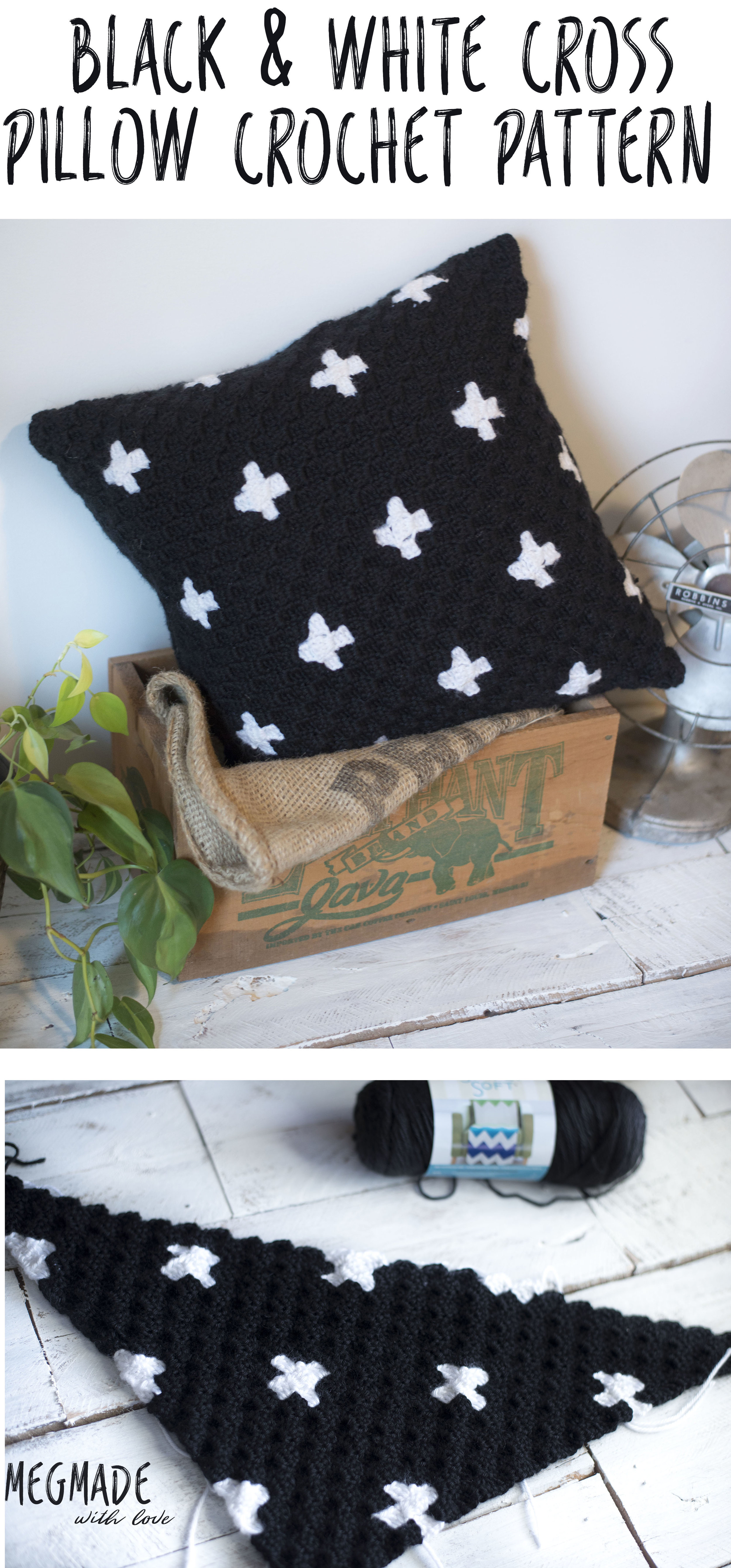
So this project has been a long-time coming, and I'm super excited to get it out into the world! I'm pretty sure I started it in February, but it just got pushed to the side for whatever reason and it seemed like I had to overcome way too many obstacles to get this sucker done! Which is kind of hard to imagine because it's just a pillow cover, but truly... I feel like this project was cursed. ha!  So to say that I am relieved to finally be typing this blog post would be an understatement. 

I will say that the way it turned out (which was PERFECT) made all the trouble worth it. I really like this pillow. It's simple, and cute and I love how the corner to corner design kind of made it look quilted.

Which leads me to my next point: this pillow was created using the corner to corner method of crocheting. If you've never tried your hand at c2c, then this is a great project to jump on in (there is a ton of good info on c2c here if you've never heard of it). Because guess what? This was my first c2c project! I was kind of hesitant to learn how to do it, but I'm really glad I finally did, because it's actually a really enjoyable way to crochet. Plus I feel like it works up quicker.

Below is the graph I created for the pillow. It is 29 rows by 29 rows, and after completed makes a 16x16 inch pillow. 

For the pillow I used Caron Simply Soft in Black and White, along with a size F crochet hook (I thought this would make the squares more "tight"). If you chose to use another worsted weight yarn, I will say that it may be larger because Caron Simply Soft is slightly thinner than many other yarns it's weight. 

So like I mentioned the pattern is for a pillow COVER, but you could make it simply a pillow if you felt so inclined. I made it with the design on the front side, and on the back I chose to do two pieces that buttoned together in black. When doing the back part, I had to learn how to crochet a c2c rectangle, which was interesting, but easy to get the hang of.

Above are the three pieces I used to make the pillow cover. I did the front in the cross design then made two smaller rectangles for the back, which I attached three buttons to.

Above are the three pieces I used to make the pillow cover. I did the front in the cross design then made two smaller rectangles for the back, which I attached three buttons to.

As far as button holes go, the cool thing about c2c is that there are little slots that naturally occur in the project that were perfect for my buttons to slip right into. I had one inch buttons and those fit perfectly.

What you'll need:
Size F hook (3.75 mm)
Caron Simply Soft yarn in Black and White (3 skeins black, 1 white)
three 1" buttons
Large tapestry needle
16x16 inch pillow (I made mine with two pieces of black fabric and poly fill)
Black thread
sewing needle

Dimensions:

Approximately 16x16 inches

Instructions:

-So like mentioned before, above is the graph I made (using Stitch Fiddle, great resource!) for the front side of the pillow cover. This will be your guide to making the pillow.

-For c2c, you begin in one corner (and it doesn't matter which corner you start in). And you read the graph diagonally. A helpful tip is to mark off what row you just did with a pen or marker.

-For the directions on how to do c2c if you've never done it, I'm going to send you to this video created by The Crochet Crowd (its how I learned).
In the video, he will teach you how to begin the c2c, increase as well as read the graph. Also this video will explain how to c2c rectangle, which is what you'll need to know for the back of the pillow cover. 

**An important note for changing colors** (I found this out the hard way) So, because the colors are so opposite, they will really stand out if you can see a color change. So what I found was, it didn't matter what color I just finished, if I was slip stitching into a different color "pixel" next, I would switch colors BEFORE slip stitching. And if I was changing from say for instance, white to black, but the next "pixel" color that I would slip stitch into was white(the same color), then I wouldn't change the color until AFTER I slip stitched. That make sense?

- So to create the front piece, you follow the instructions in the video, increasing until you reach row 29. Then after you have 29 rows, you will begin to decrease, until you are back at 1.

- Below are the two graphs for the rectangles to kind of make it easier to understand:

-I made the two rectangles that make up the back two different sizes, so they would overlap. And where the overlap is, is where the buttons will go. So unlike the square c2c, the rectangles are worked by an increase until you reach the last row of the shortest side of the rectangle (in this case the short sides are 16 and 18). Once you reach that amount, then you will begin to decrease on that side only, and you will be increasing on the other side until you reach the 29 rows you need for the bottom side. After that you begin to decrease on both sides of your work. This is also explained in the video I linked to above.

-SO.... in total you will have three crocheted pieces: the front square and the two back rectangles.

To sew together:
Take all your pieces, and place them wrong sides together. You will line up the bottoms of the rectangle pieces with the square and then overlap them in the middle. Pin your pieces together like this, making sure to pin at the "overlap".

Then you will take your tapestry needle and a long strand of black yarn, and stitch around the very edge of the pieces. Make sure to get BOTH of the rectangle pieces in the seam where they overlap. 

Once you've finished that off, turn your pillow inside out. Next you will sew on your buttons.

So like in the photo above, you can see that in the c2c design, there is a natural occurring "hole" made perfect for buttons! Make sure your buttons fit in the hole before sewing them on. ha!

I evenly spaced my three buttons on the edge of the rectangle that was under the other bigger rectangle, making sure that the buttons lined up with the natural hole I was talking about above.

Then I sewed on my buttons with my black thread and sewing needle.

Then you grab your 16x16 inch pillow and slap that awesome pillow cover on there!! Ahh, how lovely to finish another project. :) :) :) 

Enjoy your new and fancy cross pillow!

Love,
Meg