Meet the Newest Addition to the Farmhouse Series: The Farmer's Market FRESH Bag

***You can find the PDF version of this pattern in my shop by clicking here. Great for easy printing!***

Welcome to the third installment of the "Farmhouse Inspired" series! You can check out the first pattern of the series, the washcloth, by clicking here. Then if you're in the mood to make one killer wreath, then check out the Jute Farmhouse Wreath here.

Today I am pleased to bring you this awesome Farmer's Market bag! I love the neutral tones, the embroidered word fresh, and just the overall simple farminess of it. 
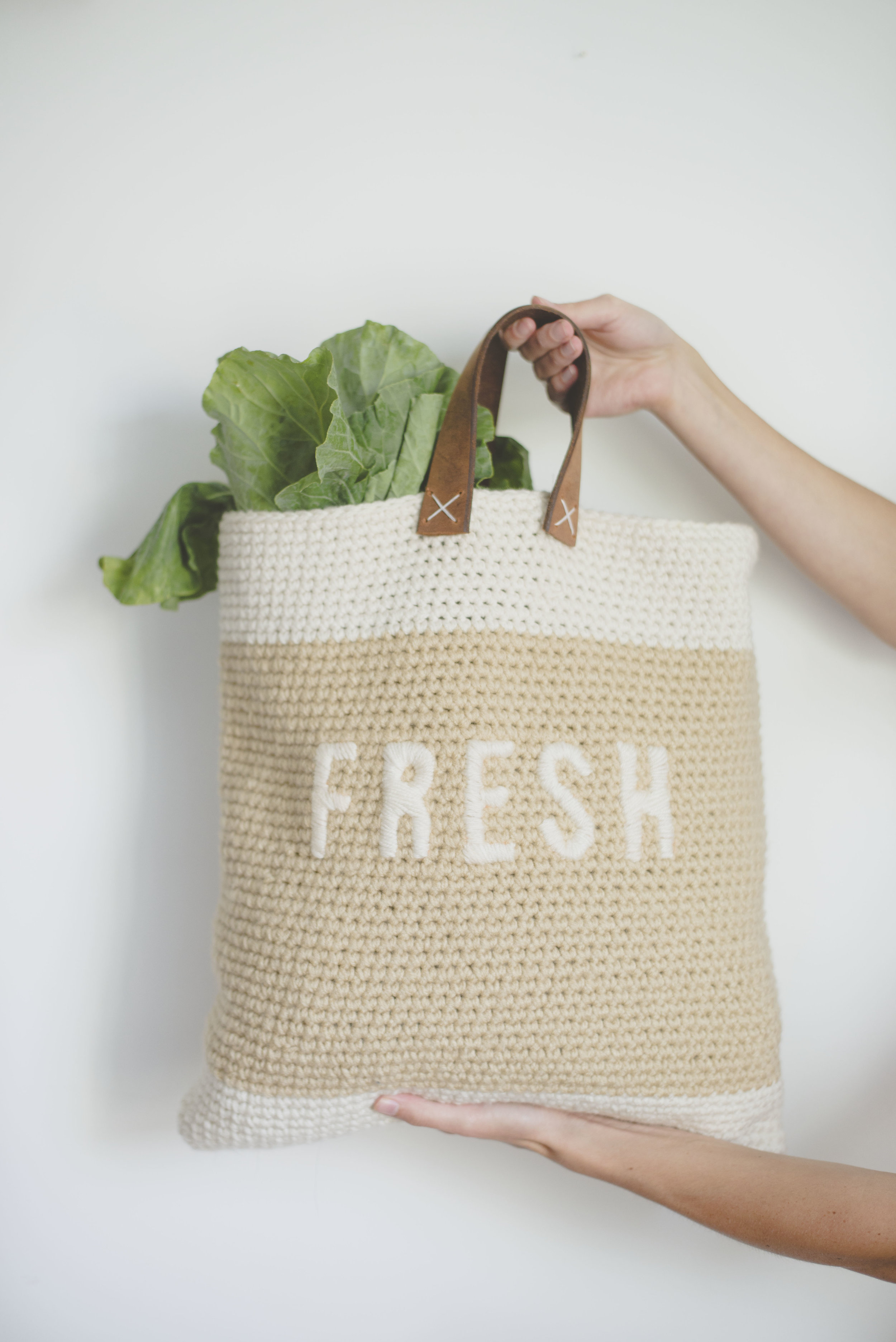
This bag is pretty darn sturdy- as it's made with two strands of worsted-weight yarn. I thought you could even line the bag with a waterproof material of your choice if you wanted to-- that'd be a great idea! 

I made my handles out of an old belt, but you could use whatever handles you'd like... pre-made or even crocheted. I chose to use a leather belt because it added such a cool vibe to the bag. And its actually very easy to sew them on! I was very much inspired by Jess over at Make and Do Crew, with her jute bag that featured thrifted leather belt handles. 

Now for the embroidered word, I provide a cool little download you can print off and use as a guide for the letters you will stitch on. You can find the download by clicking HERE. I used a satin stitch, and in my opinion, this is what "makes" the bag.

What you'll need:
Red Heart Super Saver in Aran and Buff (one skein each)
Size 6.5mm Hook (K)
stitch markers
yarn needle
"Fresh" template download (find it here) & printer to print it out
washable marker
leather belt or other handles of choice
exacto knife or other tool for poking holes like an awl or punch (I just used an exacto knife because it's what I had!) 

Gauge:
11 sc by 12 rows using 2 strands of yarn will equal a four inch square

Abbreviations:
ch=chain, st(s)=stitch(es), sc=single crochet, BLO=back loop only, 2sc=work two single crochet in one stitch

Notes:
You will use two strands of the color indicated when crocheting. I used the string from the middle of the skein as well as the strand that is wrapped around the outside.

Dimensions:
Finished bag is approximately 16.5 inches wide by 17 inches tall

Pattern:
Using two strands of ARAN: ch 46

1) **In BLO (aka working on back side of your chains you just worked)**: work 2sc in 2nd ch from hook, sc 43, 2sc in last ch, **now working on the other side of your foundation chains**: 2sc, sc 43, 2sc in last ch (44 total sts)

2-10) **you are now working in the round**: work a sc into the first st from the previous round, put a stitch marker in that stitch and sc around remaining sts (44)

11-42) follow the same instructions as in rounds 2-10, but you will be working with BUFF

43-52) follow the same instructions as in rounds 2-10, but you will be working with ARAN

Finish off and weave in ends.

To stitch the word "FRESH":

First print off your download I provided above, making sure you print it on "landscape" setting so it's sitting horizontally on your paper (it may help you to print on thicker paper-for stenciling).

Then you will cut out the letters. I used scissors, but could use an exact-o knife if you preferred. You are basically creating a stencil for you to transfer onto the bag. For the "R" I just cut out the entire middle and guessed what the center part looked like. You could cut out the middle part and then tap it in the "R" if you don't feel comfortable with that.

Then you will place your "stencil" onto the front of the bag, centering it up, about 2 inches or so below the ARAN rows. Tape the outsides to secure the stencil.

Using a washable marker (I only had an orange Crayola, ha!) you will trace the letters. I held the paper in place while I traced. Once done tracing then you take off your paper and you are ready to stitch!

For each letter, you begin by outlining the letter with a back stitch (using your ARAN colored yarn). You can see a video on how to back stitch here.

Above is the letter completely outlined. It is also showing me starting the satin stitch, by inserting my needle on the outside of the outline stitches. 

To work the satin stitch you will be inserting your needle on one side of the outline stitches and then taking it up and over diagonally to the other side of the outline. Then you will continue to do that around your letter, going over your outline and inserting your needle close to where you previously inserted your needle from the last stitch (like in the above photo).

Some of the areas were harder than others to make look pretty.. In some spots you may have to go back over some stitches that don't look uniform (like the middle bar of the "H") to make them look more smooth.

Now, you can see that my satin stitches certainly aren't perfect. But I was completely happy with how they came out. Hey, you can still read it! ;) After all your letters are complete, it's time to add on your handles. This is how I did mine...

I grabbed my leather belt, and cut two pieces that were 12 inches long. After I cut them I decided the leather was too dark, so I sanded it down. I'm very happy I did that, because I was going for a lighter leather look. 

Then when you take pictures of your process, your baby comes in to sabotage your photo.... :)

Then using my exacto knife I made four holes in the bottom inch or so of both ends. Learn from my mistake and make the holes pretty close to the edge. On my first handle my holes were closer together in the center, and it made the handle not sit as flat. So to get a nice flat handle space those holes out to secure the entire bottom of your handle.

Last you'll take needle and thread and secure your handles stitching an "x" into the holes you created. You could also use yarn if you'd like for this. 

Once all your handles are secured, it's time to hit up your farmer's market! EEEP! (Who doesn't love a good farmers market??)

Happy making my friend,
Meg

How to Crochet Around Fabric (Three Different Ways!)

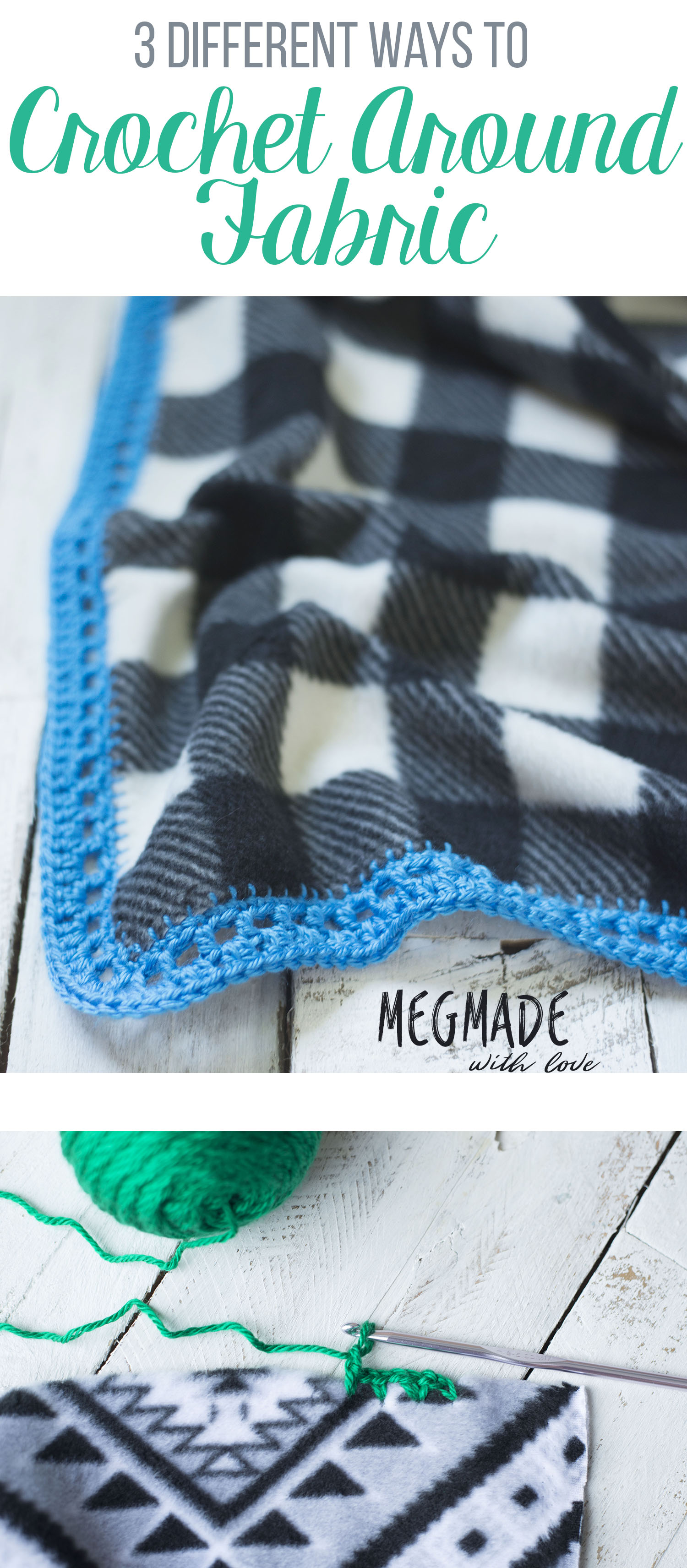
Here recently I was on a baby blanket making spree. One of my friends had a shower, and then another friend asked if I could make a couple for showers she was going to also. And in all honesty, I just didn't want to spend all my time crocheting a full blanket, so I decided to crochet around fleece, because hey, it's nice and quick. 
Now, something I try to live by is "use what ya got"... I am a thrifty gal through and through, so if I don't have a certain tool and product to achieve what I'm wanting to make, then I find a way to do it using what I already have on hand. This was one of those times. I've seen where you can make the holes into your fabric using a skip stitch rotary cutter, but I don't have one. Nor do I see myself using one all that much. So, I thought I'd show you here a couple different ways you can crochet around fabric (the last one is a tutorial provided by an outside source, using the rotary cutter).

Blanket Stitch

So for the first example, I'm going to show you how you can do a simple blanket stitch around the edge of your fabric. This was how I did my first blanket. I will say that this way wasn't exactly my favorite, as working the blanket stitch was pretty time consuming, because of the length of yarn you need to get around the whole blanket without running out and starting a new strand. If you are okay with starting new strands, then maybe that would work for you, I just try to minimize the stray ends. This method does work though, and provides a good foundation for your crochet. If you're looking for a faster way, see the second tutorial in this post below. 

 I gathered a yard of this buffalo print fleece I found at Wal Mart, a size H Hook, yarn needle and worsted weight yarn (I used Caron Simply Soft in Cobalt Blue) 

*I cut my fabric into a 3x3 foot square*

On the topic of yarn length needed to get around the blanket without having to start a new piece: I figured out (the hard way..) that I needed to use a piece of yarn that was three times the perimeter of the blanket. And to measure that I just took my yarn and lined it up with the edge of my blanket times three.

P.S. When getting fabric, make sure its something that won't fray--unless you're okay with seaming it up.

To achieve evenness between the blanket stitches, I used this trick I saw some time back on Pinterest, where you make little marks on your finger how far apart you'd like your stitches. I chose to do mine 1/4 inch apart, and 1/4 inch from the edge. I wouldn't go more than 1/2 inch in between stitches.

Now I will say this: I just eyeballed how far away from the edge I was, but if you don't feel comfortable doing that you could draw a line on your fabric with washable marker along the edge to give you a guide for how far down to insert your needle. I didn't find it too challenging to make the stitches even from the edge. 

To start the blanket stitch you'll need to knot your yarn at the end a couple times, big enough so it won't come through the hole you create with your needle. You'll thread your yarn, and insert your needle from the back and draw it all the way through (this is the bad part of the beginning, such a longgggg strand to pull through.. but it's great for when you're watching a show on Netflix ;).

Then you'll go over the edge, and back through the same spot you just entered in. Pull yarn through.

Then you'll insert the needle sideways through that stitch you just created.

Now for the rest of the stitches you will always insert your needle from the back of the fabric, using your finger as a guide for how far away from the previous stitch.

Once you pull the needle through, tug a bit of yarn through also.

Then you will insert the needle underneath the base of the strand of yarn (see above photo).

When you pull the yarn tight (don't pull too tight, or the edges will ripple!), the above photo indicates how it should look. Then you will continue around until you get to the space before your first stitch you made.

When it comes to the corners, you will follow the above steps, except you will insert your hook into the same hole three times (see photo).

Then you will connect the last and first stitch by inserting your needle sideways into the first stitch. 

Then you will insert the needle into the base of that first stitch from front to back. Then cut your yarn long enough to weave in and tie a knot to the beginning strand. 

To start your crochet border, you will insert your crochet hook into one of the blanket stitches, then draw through your yarn.

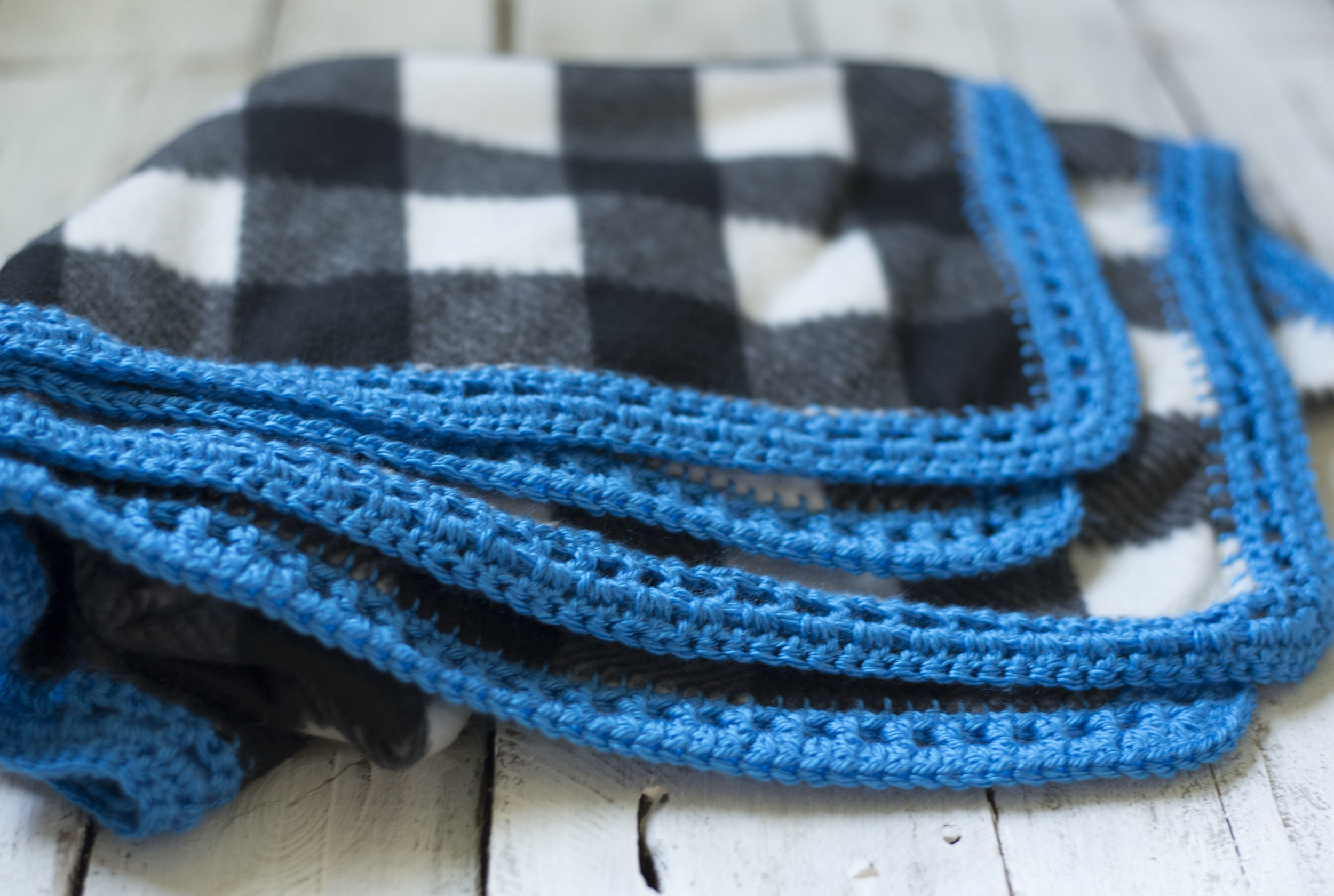
Make two chain stitches to begin your crochet stitches. Then you can tie a knot in your yarn end to secure it before weaving it in. Next you can begin to create any border you would prefer. I am going to provide the border pattern I used. I thought this one was super simple and quick. I didn't want anything frilly because I was making the blankets for baby boys. 

So since my blanket stitches were 1/4 inch apart, I single crocheted in every blanket stitch. But if your blanket stitches were further apart, like 1/5 inch I would recommend chaining one between single crochet. 

b07.jpg

So then I single crocheted around the entire blanket, working two single crochet in the corner blanket stitches.

Join to the beginning chain with a sl st.

Then ch 4.

(Skip a st, then dc into the next st, ch 1) Repeat that around your blanket, working two dc + ch 1 into the corner st, then join to 3rd ch with sl st

sl st into first ch 1 sp, ch 3, then work a dc into the same sp you sl st into

work 2 dc into the ch 1 spaces around the blanket, working 4 dc into the corner st, join to 3rd ch with sl st.

Then finish off, and weave in ends!

bl05.jpg

Seam Ripper Holes

So for the second tutorial, this was hands down my favorite way to prep the fabric for crochet because it was so easy and fast. I show you a couple ways you can make the holes, but ended up doing the latter of the two. I just couldn't get the first method to work as fast as I wanted it to, so I totally recommend doing the second way, using your finger as a guide rather than the marker and tape measure. I decided to put both of them on here though, because I thought maybe someone would prefer to do it the first way.

This first way, I aligned my tape measure about 1/4 inch from the edge, and put dots on my fabric 1/2 inch apart. 

Then using your seam ripper you could slightly push it into the fabric (BEWARE--not too much force!! It can rip through the edge) in each of the marks.

So since that method wasn't 100% my jam, I ended up using my finger as reference for how far apart the holes should go. And to just use the seam ripper as I go. On this blanket, I made them 1/2 inch apart. You can see how I did the ripping in the video below.

*be careful not to poke yourself!!*

For this blanket I also used a 5 mm (H) hook and Caron Simply Soft in Kelly green. This fabric is also at Walmart!

So after all the holes were made then you're ready to start crocheting! Draw your yarn through with your hook..

Then chain 2.

In the above photo I am demonstrating how I knotted up the back: I drew the tail end through the back of the st with my hook, and then tied a knot to secure it.

Then you work your single crochet into the holes. (For this blanket, since the holes were 1/2 inch apart, I chained one in between single crochets, if the holes were closer, at 1/4 inch then I would have just single crocheted around)

Then you continue around single crocheting (plus ch 1, if appropriate) and join to the beginning ch with sl st

*I used basically the same pattern as the first blanket (this one will have a few changes due to having the ch 1 in between the sc, if you just single crocheted around, scroll up and follow the above pattern):

sl st into the ch 1 sp, ch 4

(Skip the sc from previous row, then dc into the next ch 1 sp, ch 1) Repeat that around your blanket, working two dc + ch 1 into the corner st, then join to 3rd ch with sl st

sl st into first ch 1 sp, ch 3, then work a dc into the same sp you sl st into

work 2 dc into the ch 1 spaces around the blanket, working 4 dc into the corner st, join to 3rd ch with sl st.

Then finish off, and weave in ends!

Using a Rotary Cutter

I thought I'd offer this resource in case someone has a rotary cutter and would prefer to prep the fabric that way. I found this one over at Repeat Crafter me and it can be found here.

And that, my friend is how you can use what ya got to crochet around fabric. Which I can attest this makes a great baby shower gift-- It's easy, fast and you still get that special "handmade" touch!

Happy making,
Meg